
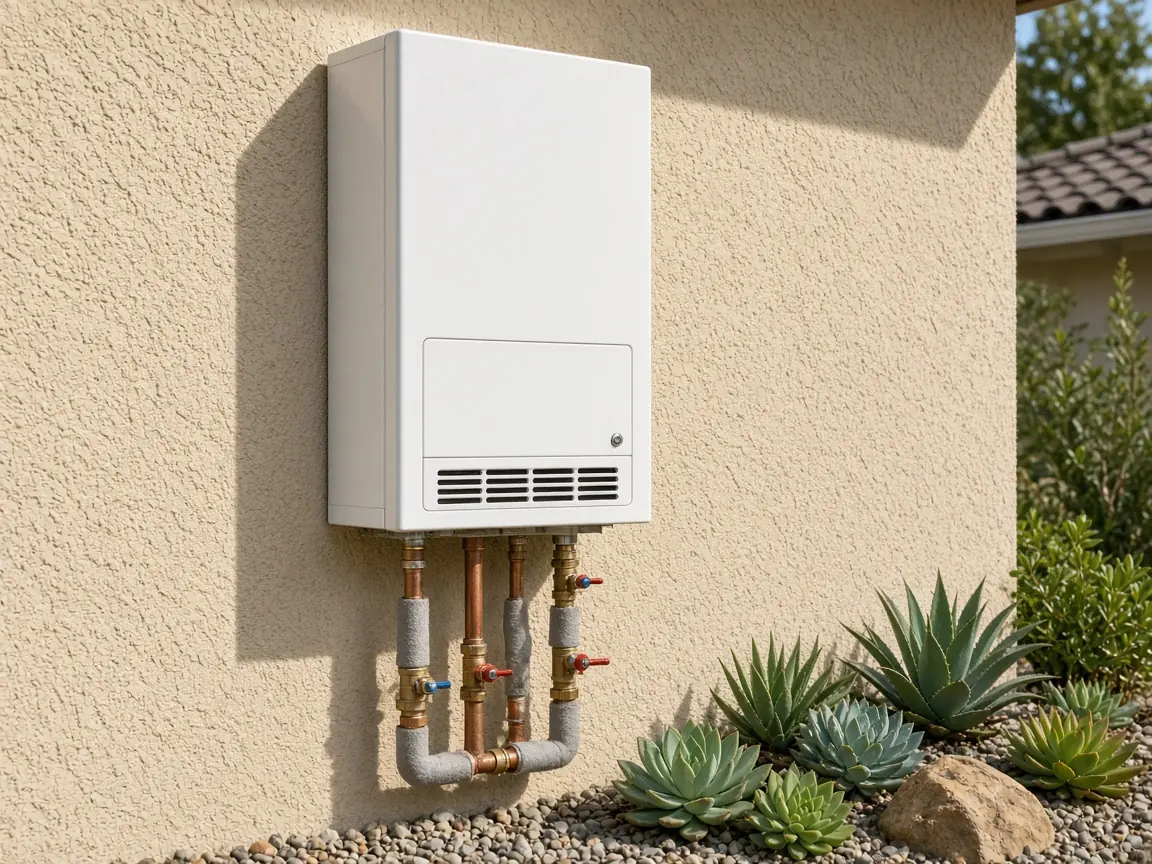
For most Fullerton homes, the choice comes down to three things: how much hot water you use at once, whether your gas line and venting can support a tankless unit, and how much you value garage space and lifespan over upfront cost. A new tank is usually the simpler, cheaper swap. Tankless costs more to install but delivers continuous hot water and often lasts longer.
How each type works
A tank heater keeps 40 to 75 gallons hot all the time, losing some heat through the walls of the tank (standby loss). When the hot water runs out, you wait while it reheats. A tankless heater fires a powerful burner only when water flows, so it never runs out, but it can only heat so many gallons per minute. A heat pump water heater is a tank with a heat pump on top that moves heat from the air into the water. ENERGY STAR's ENERGY STAR water heater guide explains the efficiency differences.
Side-by-side
| Factor | Tank | Tankless |
|---|---|---|
| Hot water supply | Limited to the tank, then recovery time | Continuous, limited by flow rate |
| Space | Floor space in garage or closet | Wall-mounted, indoor or outdoor |
| Typical install in an existing home | Usually a like-for-like swap | Often needs gas line upsizing, new venting, an outlet |
| Maintenance | Periodic flushing, anode checks | Periodic descaling, filter cleaning |
| Lifespan | Commonly around 8 to 12 years | Often longer with maintenance |
| Hard water effect | Sediment in the tank | Scale in the heat exchanger |
Not sure what your water heater needs? Talk it through by phone.
Call 000 000 0000What about Fullerton homes affects the choice?
- Gas line size. A tankless unit can draw several times the gas of a tank at full fire. Many ranch homes built in the 1950s and 1960s have gas lines sized for a tank, a furnace and a range, so the line from the meter may need upsizing.
- Garage installations. Most Fullerton houses keep the heater in the garage. Moving to an outdoor tankless unit frees floor space and avoids running vent pipe through the garage.
- Hard water. Local water is generally hard, so a tankless unit here will need descaling, and some owners add a scale-reduction filter or softener.
- Household size. Bigger households that run showers back to back benefit most from tankless. A couple with modest use may be happy with a tank.
When does a tank make more sense?
When the existing tank failed and you need hot water back with the least work. When the gas line upgrade would be long or difficult. When you'd rather not commit to annual descaling. Or when your budget is tight. A properly sized, well-installed tank is a perfectly good choice.
When does tankless make more sense?
When you want continuous hot water, plan to stay long enough to benefit from the longer lifespan, want garage space back or are remodeling anyway and can plan the gas and venting work. Ask for the gas line work to be itemized in any quote.
Where heat pump units fit in
If you have, or are willing to add, a 240-volt circuit and have space with airflow, a heat pump water heater is another strong option, especially as Southern California moves toward lower-emission equipment. Programs such as TECH Clean California have offered incentives. Check current details. See heat pump water heater installation.
Getting quotes
Ask for each option priced the same way: equipment, labor, gas line, venting, electrical, permit and haul-away. Ask how the provider sized each unit, and get warranty terms in writing.
When should you call about this?
Call when the problem keeps coming back, when there's water where it shouldn't be, when a fix means opening gas, venting or electrical parts, or when you're weighing repair against replacement. Describe what you've noticed, give the heater's fuel type, size and age, and share your Fullerton address or cross streets. You'll hear on the call whether your address is covered.
Sources
Checked on November 13, 2026. Rules and programs change, so confirm anything important with the agency.